
Berberine and menopause: what everyone needs to know
Berberine is an alkaloid that is widely present in barks, leaves, twigs, rhizomes, roots, and stems of several medicinal plants species. The most commonly discussed plant species containing Berberine are: Berberis vulgaris (barberry), Berberis aristata (tree turmeric), Mahonia aquifolium (Oregon grape), and Hydrastis canadensis (goldenseal).
We commonly think of berberine as a capsule supplement but the component is in fact extracted from different plants to make the capsules we purchase as a supplement.
"Many clinical and experimental studies suggest that berberine has several pharmacological properties, such as immunomodulatory, antioxidative, cardioprotective, hepatoprotective, and renoprotective effects." (Neag, 2018)
Is Berberine considered "Nature's ozempic"?
Berberine supplements offer menopausal women support for metabolic health and cardiovascular risk by activating AMPK pathways similar to calorie restriction. However, counter to what many will say on social media, Berberine's action is very different then the medications GLP-1 RA.
Unlike GLP-1 RA medications like Ozempic, Wegovy, Monjauro, etc., which mimic gut hormones to suppress appetite via injections and often can cause nausea or other digestive side effects, berberine is plant-derived, oral, and promotes insulin sensitivity with milder gut effects.
The mechanism of action is not the same as medications like the GLP-1 RA and are no where near as predictable in terms of it's effect on blood sugar, weight loss and other lipid or cardiovascular risk markers. Berberine is not a replacement for these medications.
Key Benefits of Berberine for Menopausal Women
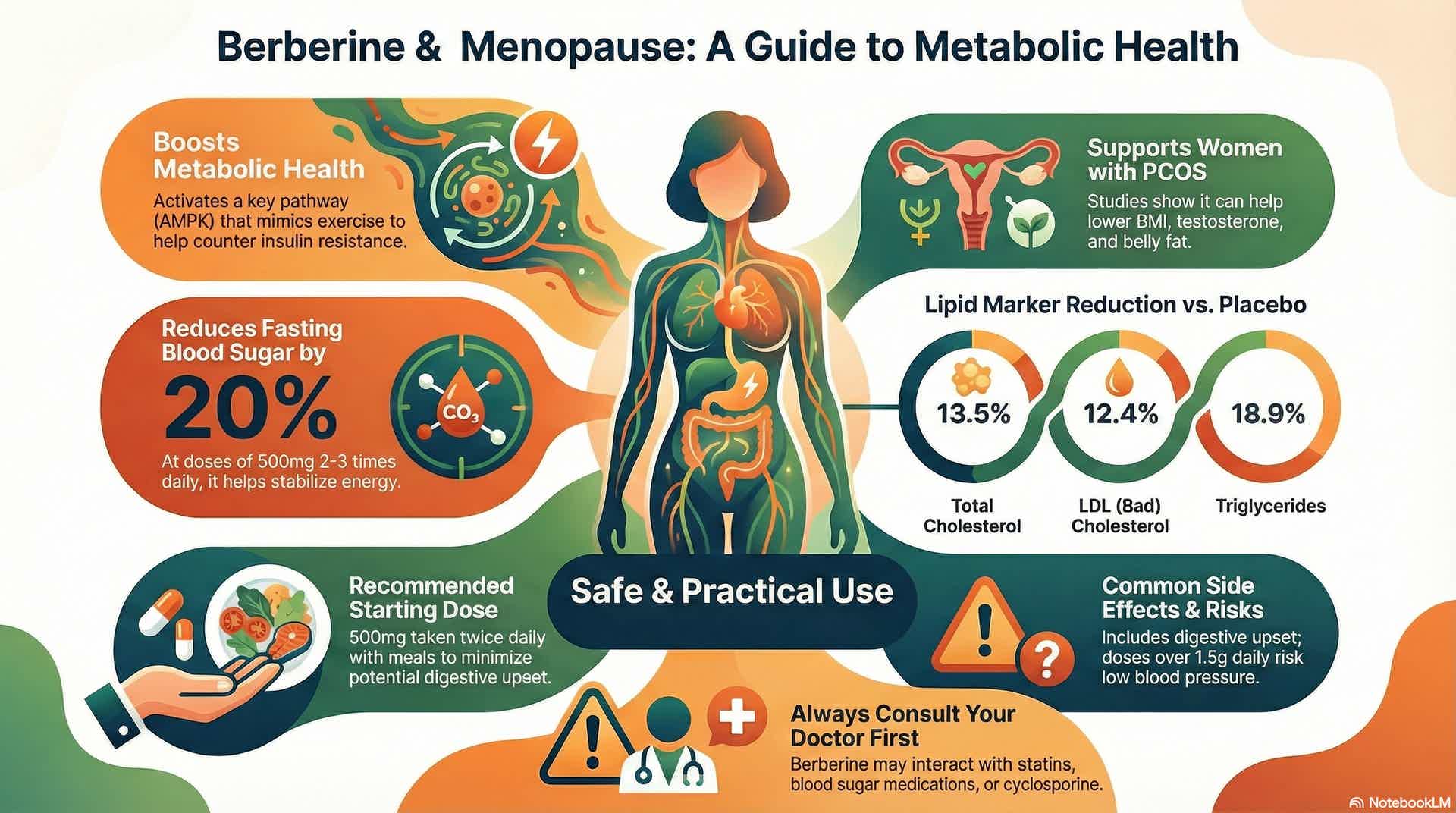
Research shows berberine reduces cholesterol, triglycerides, and inflammation, which could also support heart health amid estrogen decline. In women with PCOS transitioning to menopause, 550mg twice daily lowered BMI, testosterone, and belly fat over 60 days.
"Berberine seems to be a promising preventive treatment in the initial key steps of atherogenesis." (Caliceti, et al., 2015)
Berberine and Metabolic Support in Menopause
Berberine works by activating adenosine monophosphate-activated protein kinase (AMPK) a mechanism that mimics the beneficial effects associated with exercise and fasting. AMPK can enhance glucose uptake and fat metabolism, countering menopause-related insulin resistance and weight gain. Studies show 500mg 2-3 times daily reduces fasting blood sugar by 20% and HbA1c, aiding energy stability during hormonal shifts.
"Berberine exerts its effects through the activation of AMP-activated protein kinase (AMPK), enhancing glucose uptake in peripheral tissues, promoting lipid metabolism, and influencing fasting plasma glucose (FPG) and TG levels. Additionally, berberine reduces reactive oxygen species production and increases antioxidant enzyme activity, thereby mitigating oxidative stress that contributes to hyperglycemia (Zhang et al., 2022; Rafiei et al., 2023). Berberine has also been shown to increase HDL-C levels, exhibiting lipid-modulating properties (Rondanelli et al., 2023). Research has demonstrated that berberine downregulates the TMAO-mediated endoplasmic reticulum stress pathway, improving vascular dysfunction and lowering blood pressure (Yan et al., 2024). In various experimental models, berberine has been shown to reduce adipose tissue mass and inhibit fat accumulation." (Liu, et al., 2025)
Berberine and Lipid Markers
High levels of low-density lipoprotein (LDL) and their oxidized counterpart, oxidized LDL (oxLDL), in the blood vessels represent a major risk factor for endothelial dysfunction and atherosclerosis for women during the menopause transition. Post-menopausal estrogen drop negatively impacts LDL and triglycerides. Berberine has been shown to lower total cholesterol (TC) by 13.5%, LDL 12.4%, and triglycerides 18.9% versus placebo, thus vascular risks. Combined with isoflavones, it improved vasomotor symptoms like hot flashes in dyslipidemic (high cholesterol) women over 12 weeks.
"The lipid-lowering activity of Berberine, alone or in association with other nutraceuticals, has been clearly confirmed in a relatively large number of randomized clinical trials, involving a large part of women (usually a half, almost all in peri- or postmenopausal age). In a large placebo-controlled, randomized clinical trial, it has been reported that short-term consumption of a combined nutraceutical containing isoflavones and Berberine out on 120 mild dyslipidemic postmenopausal women significantly lowered plasma total cholesterol, LDL cholesterol, and TG improving menopausal symptoms compared with placebo." (Caliceti, et al., 2015)
High levels of low-density lipoprotein (LDL) and their oxidized counterpart, oxidized LDL (oxLDL), in the blood vessels represent a major risk factor for endothelial dysfunction and atherosclerosis.
Berberine combined with Metformin in PCOS patients
For patients with polycystic ovarian syndrome (PCOS), the combined use of Berberine (500-600mg twice or three times daily) when combined with metformin for slightly increased weight loss. It may also be considered as an addition to other insulin sensitizers when berberine would be beneficial for other aspects of health, such as improving lipid profiles or addressing hepatic steatosis "fatty liver" or MASLD/NAFLD - non alcoholic fatty liver disease. However, it's important to note that most PCOS studies have only used berberine for up to 3 months, while non-PCOS studies have used it for up to 6 months.
Practical Dosing and Monitoring Berberine Supplementation
Most research has shown that doses starting at 500mg twice daily with meals minimize GI upset. Some patients can cycle 3 months on, 1 off. Monitor blood sugar if diabetic; avoid with cyclosporine. Always speak to your primary care provider or naturopathic doctor first before beginning any supplement.
Risks and Cautions with Berberine Supplementation
Common side effects include digestive upset; it may interact with statins or blood sugar meds, so consult a doctor. Doses over 1.5g daily risk low blood pressure. It is typically contraindicated for pregnant women. As with any supplementation, you should always consult with your primary care provider prior to starting.
As with all medications and supplementation for health, there is not replacement for healthy diet and lifestyle changes.
Have more questions about Berberine supplementation and your cardiometabolic health? Book your free discovery call with Dr. Amy here.
To your best health,
Dr. Amy J. Tung, ND, MSCP
Naturopathic Doctor
Menopause Society Certified Practitioner
References:
Caliceti C, Rizzo P, Cicero AF. Potential benefits of berberine in the management of perimenopausal syndrome. Oxid Med Cell Longev. 2015;2015:723093. doi: 10.1155/2015/723093. Epub 2015 Feb 17. PMID: 25785174; PMCID: PMC4346702.
Liu D, Zhao H, Zhang Y, Hu J, Xu H. Efficacy and safety of berberine on the components of metabolic syndrome: a systematic review and meta-analysis of randomized placebo-controlled trials. Front Pharmacol. 2025 Jul 16;16:1572197. doi: 10.3389/fphar.2025.1572197. PMID: 40740996; PMCID: PMC12307485.
Neag MA, Mocan A, Echeverría J, Pop RM, Bocsan CI, Crişan G, Buzoianu AD. Berberine: Botanical Occurrence, Traditional Uses, Extraction Methods, and Relevance in Cardiovascular, Metabolic, Hepatic, and Renal Disorders. Front Pharmacol. 2018 Aug 21;9:557. doi: 10.3389/fphar.2018.00557. PMID: 30186157; PMCID: PMC6111450.
Disclaimer:
The information in this blog is for educational and informational purposes only. It is not intended to be a substitute for professional medical advice, diagnosis, or treatment. Always seek the guidance of your doctor or other qualified health professional with any questions regarding a medical condition or treatment. Never disregard professional medical advice or delay seeking treatment because of something you have read in this blog.
Individual results may vary, and the strategies discussed here are not guaranteed to work for everyone. This content does not create a patient-client relationship and should not be used as a replacement for personalized medical care.
